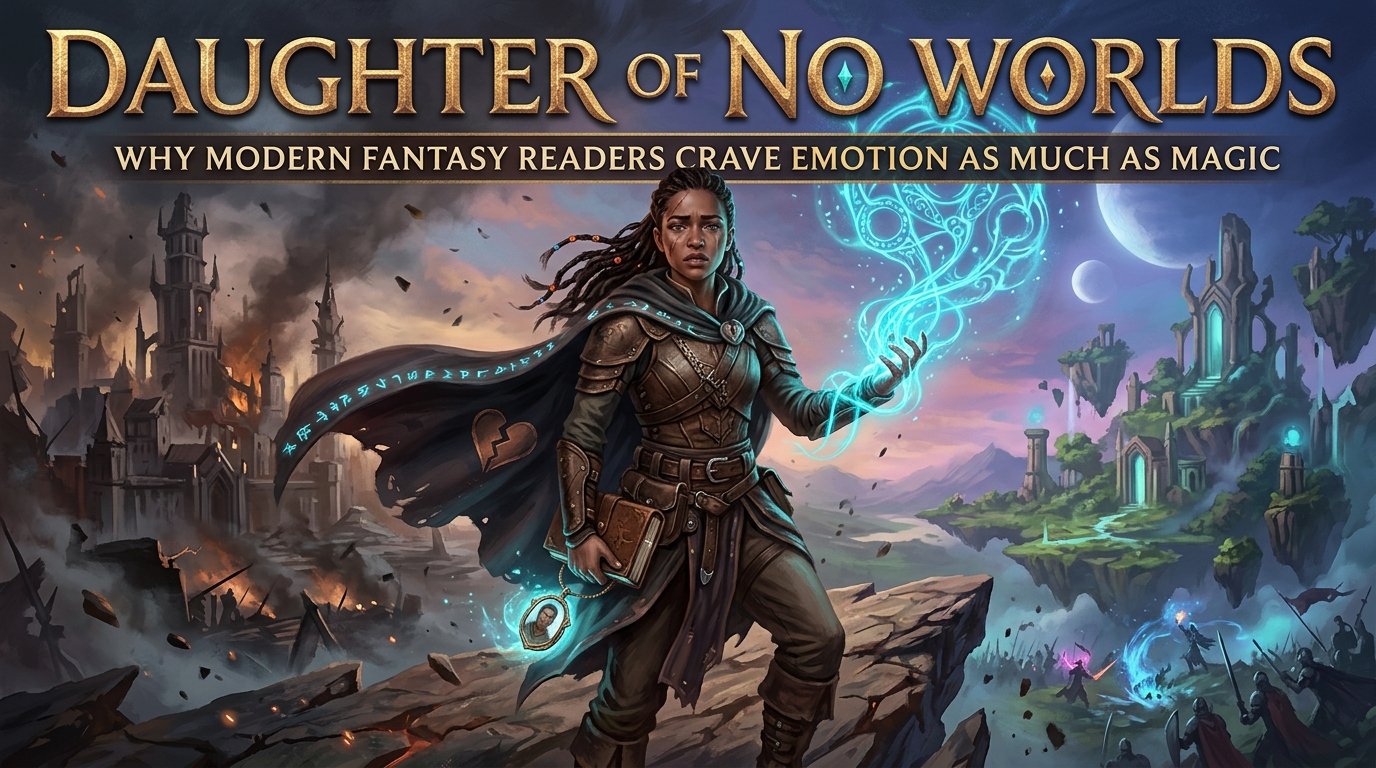
The fantasy genre has always promised escape. Ancient kingdoms, dangerous magic systems, immortal warriors, and impossible quests offer readers an alternative to ordinary life. Yet the novels that leave lasting cultural impact rarely succeed because of spectacle alone. They resonate because beneath the dragons, wars, and mythical landscapes, they speak directly to human emotion. That emotional depth explains why Daughter of No Worlds has emerged as one of the most discussed fantasy novels among modern readers.
Written by Carissa Broadbent, Daughter of No Worlds has gained recognition not simply as another fantasy romance title, but as a story that combines political tension, trauma, resilience, and intimacy with unusually grounded emotional storytelling. In an era where digital reading communities increasingly shape publishing trends, the novel represents a broader shift in what audiences now expect from fantasy literature.
Readers no longer want only elaborate world-building. They want emotional realism inside extraordinary worlds. They seek characters whose struggles feel psychologically authentic, even when surrounded by magic and warfare.
For entrepreneurs, media analysts, and culturally aware audiences, the popularity of Daughter of No Worlds reveals something important about modern storytelling: emotional intelligence has become as valuable as imagination.
The Rise of Emotionally Intelligent Fantasy
Fantasy literature has evolved dramatically over the past two decades. Earlier generations of fantasy often focused heavily on epic battles, external conflict, and large-scale world construction. While those elements remain popular, contemporary audiences increasingly prioritize character psychology and emotional complexity.
The success of Daughter of No Worlds reflects this transformation clearly.
At the center of the novel is not simply a heroic journey, but a deeply personal story about survival, identity, and healing. The protagonist’s experiences with oppression, trauma, and self-discovery give the narrative emotional gravity that extends beyond traditional fantasy conventions.
This shift aligns with broader cultural changes in entertainment consumption. Audiences today gravitate toward stories that feel emotionally layered and psychologically aware. They want characters who struggle internally as much as externally.
Modern fantasy readers expect vulnerability alongside power.
That expectation has reshaped the genre itself.
Why Readers Connect So Deeply With the Story
One reason Daughter of No Worlds resonates so strongly is that its emotional stakes feel intimate despite the large fantasy setting.
The novel explores themes many readers recognize personally:
displacement,
loneliness,
resilience,
trust,
and the search for belonging.
Fantasy often works best when it transforms emotional experiences into symbolic worlds. Magical systems, political conflicts, and fictional societies become metaphors for real human struggles.
In this case, the emotional realism beneath the fantasy framework creates unusually strong reader attachment.
The protagonist’s journey is not simply about mastering power. It is about reclaiming agency after trauma and learning how to navigate relationships shaped by fear, survival, and emotional uncertainty.
This emotional grounding distinguishes the novel from more formulaic fantasy stories that rely primarily on spectacle or romance tropes.
Readers increasingly reward narratives that feel emotionally honest, even within highly imaginative settings.
The Digital Communities Fueling Fantasy’s Growth
The rise of Daughter of No Worlds also reflects the growing influence of online reading culture.
Platforms like BookTok, Goodreads, Reddit, and fantasy-focused online communities now play a major role in determining which books gain visibility. Unlike traditional publishing eras dominated by critics and bookstore placement, modern readers often discover novels through emotional reactions shared online.
This environment favors books that generate strong personal investment.
Readers do not simply recommend titles anymore. They discuss emotional scenes, analyze character dynamics, share annotated passages, and create communities around shared reading experiences.
Fantasy literature benefits particularly well from this ecosystem because immersive worlds naturally encourage long-term audience engagement.
The popularity of Daughter of No Worlds demonstrates how emotionally resonant storytelling spreads organically through digital conversation.
Readers become advocates when stories feel personally meaningful.
The Evolution of Fantasy Audiences
Modern fantasy audiences differ significantly from those of earlier publishing generations.
Today’s readers often seek narratives that balance escapism with emotional reflection. They want stories capable of transporting them into new worlds while still addressing recognizable emotional realities.
This dual expectation has changed how fantasy authors approach storytelling.
The success of novels like Daughter of No Worlds suggests readers are increasingly drawn toward character-driven fantasy rather than purely plot-driven narratives. Emotional arcs now carry equal weight to magical systems or battle sequences.
Importantly, audiences also value relational complexity more than before. Romantic dynamics, mentorships, friendships, and emotional trust have become central components of fantasy storytelling rather than secondary subplots.
This evolution mirrors larger cultural trends toward emotional openness and psychological awareness in media.
Fantasy as a Reflection of Modern Anxiety
Although fantasy appears disconnected from reality on the surface, the genre often reflects contemporary social anxieties more effectively than realism.
Daughter of No Worlds explores systems of power, violence, inequality, and emotional survival in ways that resonate strongly with modern readers navigating uncertain cultural and economic environments.
Fantasy worlds provide emotional distance that allows audiences to process difficult themes safely.
This is one reason emotionally grounded fantasy has become increasingly popular during periods of social instability. Readers seek stories that acknowledge suffering while still offering hope, resilience, and transformation.
The novel’s balance between darkness and emotional healing reflects this cultural demand.
Audiences today are less interested in simplistic heroism. They respond more strongly to flawed individuals learning how to survive emotionally complicated worlds.
The Publishing Industry’s Shift Toward Character-Driven Fantasy
The success of Daughter of No Worlds also illustrates broader changes within publishing itself.
Traditional fantasy publishing once emphasized large-scale epics targeted primarily toward male readership demographics. Contemporary fantasy markets are significantly more diverse in both audience and storytelling style.
Character-driven fantasy with strong emotional narratives now commands substantial commercial success.
This shift has encouraged publishers and independent authors alike to invest more heavily in stories centered around intimacy, vulnerability, and psychological depth.
| Traditional Epic Fantasy | Modern Character-Driven Fantasy |
|---|---|
| Focus on kingdoms and wars | Focus on emotional journeys |
| Plot-first storytelling | Character-first storytelling |
| External conflict dominates | Internal conflict equally important |
| Heroic archetypes | Morally layered protagonists |
| Broad political themes | Personal emotional stakes |
The table highlights how audience preferences have evolved over time.
Modern readers increasingly value emotional immersion as much as narrative scale.
Why Female-Led Fantasy Stories Are Thriving
One of the most significant developments in fantasy publishing has been the rise of female-led narratives with emotionally nuanced protagonists.
Daughter of No Worlds belongs to this larger movement.
Readers increasingly seek stories where strength is portrayed not simply through physical dominance, but through resilience, intelligence, emotional endurance, and adaptability.
This reflects changing cultural conversations around power itself.
Modern audiences often connect more deeply with protagonists who struggle psychologically and emotionally rather than appearing invulnerable from the beginning. Characters who heal, evolve, and rebuild themselves feel more relatable than idealized heroes.
Importantly, these stories are not only attracting female audiences. Emotional complexity has broad appeal across readership demographics because it creates richer, more human storytelling.
Fantasy readers today expect characters who feel emotionally real.
The Business of Emotional Storytelling
For entrepreneurs and creative professionals, the rise of emotionally driven fantasy offers important insights into modern consumer behavior.
Audiences increasingly prioritize emotional engagement over surface-level spectacle. Whether in literature, entertainment, branding, or technology, people respond most strongly to experiences that feel psychologically meaningful.
This principle extends far beyond publishing.
Successful brands now rely heavily on emotional narrative. Companies build loyalty not merely through products, but through identity, storytelling, and community connection.
The popularity of Daughter of No Worlds demonstrates how emotional resonance creates audience loyalty more effectively than formulaic content.
Readers who feel emotionally invested become long-term advocates.
This dynamic mirrors broader creator-economy trends where authenticity and emotional depth increasingly determine cultural relevance.
The Role of Escapism in Modern Culture
Escapism itself has evolved in the digital era.
Earlier forms of escapist entertainment often focused purely on distraction. Modern audiences, however, seek stories that provide both escape and emotional processing simultaneously.
Fantasy novels like Daughter of No Worlds succeed because they offer immersive worlds while still confronting deeply human questions about pain, identity, trust, and resilience.
This combination feels emotionally restorative for many readers.
In overstimulated digital environments filled with constant information and social pressure, emotionally rich fantasy offers something increasingly rare: sustained emotional immersion.
Readers are not simply escaping reality. They are searching for emotionally meaningful experiences within fictional worlds.
Conclusion: Why Daughter of No Worlds Reflects the Future of Fantasy
The popularity of Daughter of No Worlds signals more than the success of a single fantasy novel. It reflects a broader transformation in what modern audiences value in storytelling.
Readers today crave emotional complexity alongside imaginative world-building. They seek stories where vulnerability exists beside strength, and where psychological realism matters as much as magical systems.
Carissa Broadbent’s novel resonates because it understands this balance. It delivers fantasy not merely as spectacle, but as emotional exploration.
In many ways, the future of fantasy literature will likely continue moving in this direction. Audiences increasingly expect stories that feel emotionally intelligent, culturally aware, and deeply human even within extraordinary settings.
The enduring appeal of fantasy has never been about escaping humanity entirely. It has always been about understanding it more clearly through imagined worlds.
And that is precisely why Daughter of No Worlds continues finding such a devoted audience.