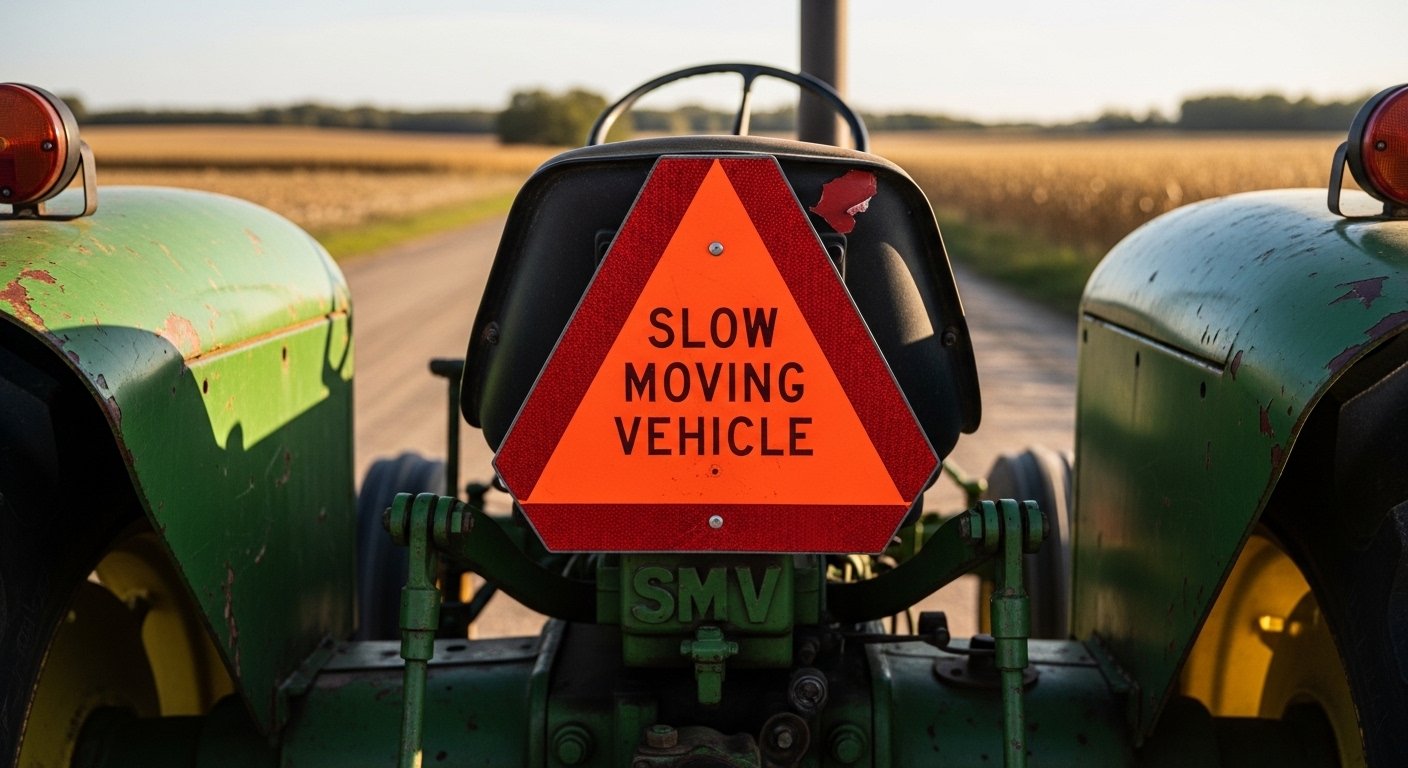
On a quiet country road just before sunset, a driver rounds a gentle bend and suddenly notices a bright orange triangle glowing in the distance. The vehicle ahead is moving slowly—a tractor pulling equipment from one field to another. Thanks to the highly visible marker on its rear, the approaching driver quickly reduces speed and passes safely.
That simple reflective symbol is known as a slow moving vehicle sign, and despite its modest appearance, it plays a crucial role in road safety across rural and agricultural communities.
For decades, the slow moving vehicle sign has served as a universal signal warning drivers that a vehicle ahead is traveling significantly below normal traffic speeds. Whether attached to farm machinery, construction equipment, or horse-drawn carriages, the symbol helps prevent collisions by giving drivers the time they need to react.
In a world increasingly focused on advanced vehicle technology and automated driving systems, the slow moving vehicle sign remains a powerful reminder that even the simplest innovations can save lives.
What Is a Slow Moving Vehicle Sign?
A slow moving vehicle sign is a distinctive road safety symbol designed to identify vehicles that travel at reduced speeds, typically below 25 miles per hour (about 40 kilometers per hour).
The sign features a fluorescent orange triangle surrounded by a red reflective border. This combination of colors ensures high visibility both during the day and at night.
Mounted on the rear of slow-moving vehicles, the sign alerts faster drivers approaching from behind that they should reduce speed and prepare to pass cautiously.
The symbol has become widely recognized in many countries and is especially common in rural areas where agricultural equipment regularly shares roads with standard passenger vehicles.
Despite its simple design, the slow moving vehicle sign represents an important communication tool between drivers operating vehicles with very different speed capabilities.
The Origins
The idea behind the slow moving vehicle sign emerged in the mid-twentieth century when rural road safety became a growing concern.
As automobiles became more powerful and widespread, traffic speeds increased dramatically. Meanwhile, farmers and rural workers continued using tractors and other equipment designed primarily for field work rather than road travel.
This mismatch created a dangerous situation. Drivers traveling at highway speeds sometimes encountered slow agricultural vehicles with little warning, leading to accidents and near collisions.
Researchers and transportation safety experts began searching for a visual solution that could immediately communicate reduced speed to approaching drivers.
The triangular design was chosen because it stands out from most other road signs. The bright fluorescent color ensures daytime visibility, while reflective borders make the symbol easy to spot in low-light conditions.
Over time, the slow moving vehicle sign became standardized and widely adopted across agricultural regions.
Why the Slow Moving Vehicle Sign Matters
Although the slow moving vehicle sign may appear basic, its impact on road safety is significant.
One of the most common causes of rural traffic accidents involves vehicles approaching slow-moving machinery too quickly. Drivers may assume that all vehicles ahead are traveling at typical road speeds, leaving little time to react when they encounter a tractor or equipment traveling much slower.
The sign provides immediate visual information that allows drivers to adjust their behavior.
When drivers see the bright triangle, they instinctively slow down and prepare to pass carefully. This simple warning dramatically reduces the risk of rear-end collisions.
Beyond agricultural equipment, the sign also protects operators of construction machinery, road maintenance vehicles, and other specialized equipment that must occasionally travel on public roads.
In this way, the symbol creates a shared understanding between different types of road users.
Where Slow Moving Vehicle Signs Are Used
The slow moving vehicle sign appears in a variety of transportation environments, particularly in regions where slow equipment interacts with regular traffic.
Farm machinery is the most common example. Tractors, harvesters, and other agricultural vehicles frequently move between fields using local roads.
Horse-drawn carriages also use these signs in certain communities where traditional transportation remains part of daily life.
Construction and maintenance equipment sometimes carry the sign when traveling between work sites.
Even specialized vehicles such as road sweepers or mobile utility equipment may display the symbol when operating below normal traffic speeds.
These diverse applications demonstrate how a single visual cue can improve safety across multiple industries.
Key Features of a Slow Moving Vehicle Sign
To function effectively, the slow moving vehicle sign must follow specific design and placement standards.
| Feature | Description | Safety Benefit |
|---|---|---|
| Fluorescent Orange Center | Bright triangular background | High daytime visibility |
| Red Reflective Border | Reflective outline around triangle | Nighttime visibility |
| Rear Mounting | Placed on the back of the vehicle | Alerts approaching drivers |
| Durable Materials | Weather-resistant construction | Long-term reliability |
| Standardized Shape | Recognizable triangular design | Instant driver recognition |
These design elements ensure the sign remains easily visible in different lighting conditions and road environments.
Regulations and Legal Requirements
In many regions, the slow moving vehicle sign is not just a recommendation—it is required by law for certain types of vehicles.
Transportation authorities often mandate the use of the sign on vehicles that cannot exceed specific speed limits. This ensures that all road users receive consistent visual warnings when approaching slower traffic.
Farmers and equipment operators are typically responsible for maintaining the sign in good condition. A faded or damaged symbol may reduce visibility and compromise safety.
Regulations may also specify proper mounting height and placement to ensure the sign remains unobstructed and visible from a distance.
These rules help maintain the effectiveness of the system across diverse transportation environments.
Technology and the Future of Vehicle Visibility
As transportation technology evolves, the role of the slow moving vehicle sign continues to intersect with modern innovations.
Advanced driver assistance systems (ADAS) and autonomous vehicle technologies rely heavily on sensors and cameras to interpret road conditions. Highly visible markers such as the slow moving vehicle sign can assist these systems in identifying slower traffic.
Meanwhile, reflective materials used in modern signs have improved significantly, offering greater durability and brightness.
Some transportation experts have even explored digital or electronic alternatives that could communicate speed information directly to nearby vehicles.
Despite these advancements, the traditional triangular sign remains remarkably effective. Its simplicity allows it to function without power, software, or connectivity—qualities that make it reliable in virtually any environment.
Safety Awareness and Driver Education
While the slow moving vehicle sign provides a clear warning, its effectiveness also depends on driver awareness.
Motorists must understand the meaning of the symbol and respond appropriately when they encounter it on the road. Driver education programs often include explanations of the sign and safe passing practices.
For example, drivers should slow down, maintain a safe distance, and only pass when visibility allows.
In rural areas, local safety campaigns sometimes emphasize the importance of sharing roads with agricultural equipment.
Such awareness helps prevent accidents and ensures that both farmers and motorists can travel safely.
A Symbol of Shared Roads
One of the most important aspects of the slow moving vehicle sign is what it represents: cooperation between different types of road users.
Modern transportation networks accommodate everything from high-speed passenger vehicles to equipment designed for agriculture or construction. Each plays a vital role in supporting economies and communities.
The bright triangular symbol reminds drivers that roads are shared spaces where patience and awareness are essential.
In many ways, the sign serves as a small but powerful example of how thoughtful design can improve everyday safety.
Conclusion: The Enduring Power of Simple Innovation
In a world filled with complex technologies and advanced transportation systems, the slow moving vehicle sign stands out for its simplicity.
A single brightly colored triangle communicates a message that drivers instantly understand: slow down, stay alert, and proceed with caution.
For decades, this symbol has helped prevent accidents and protect the people who operate essential equipment on public roads. Its effectiveness demonstrates that innovation does not always require sophisticated technology—sometimes the most impactful solutions are also the simplest.
As transportation continues evolving, the slow moving vehicle sign will likely remain a familiar presence on rural roads, quietly reminding drivers that safety often begins with awareness.